From Optimizing Engagement to Measuring Value
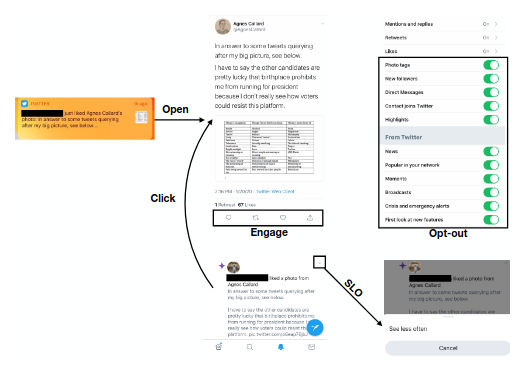
Most recommendation engines today are based on predicting user engagement, e.g. predicting whether a user will click on an item or not. However, there is potentially a large gap between engagement signals and a desired notion of "value" that is worth optimizing for. We use the framework of measurement theory to (a) confront the designer with a normative question about what the designer values, (b) provide a general latent variable model approach that can be used to operationalize the target construct and directly optimize for it, and (c) guide the designer in evaluating and revising their operationalization. We implement our approach on the Twitter platform on millions of users. In line with established approaches to assessing the validity of measurements, we perform a qualitative evaluation of how well our model captures a desired notion of "value".
Read the full research report
Publication details
Authors: Smitha Milli, Luca Belli, Moritz Hardt
Publication date: 2021/3/3
Book: Proceedings of the 2021 ACM Conference on Fairness, Accountability, and Transparency
Pages: 714-722
Subscribe to my newsletter to get the latest updates and news